🎯 Mission Brief
You're about to become a zoo map expert! 🎉
Look for the red START HERE point on the map.
🧭 What You'll Learn:
- Grid References: Letters and numbers
- Directions: N, S, E, W
- Distance: Counting squares
- Map Skills: Reading symbols
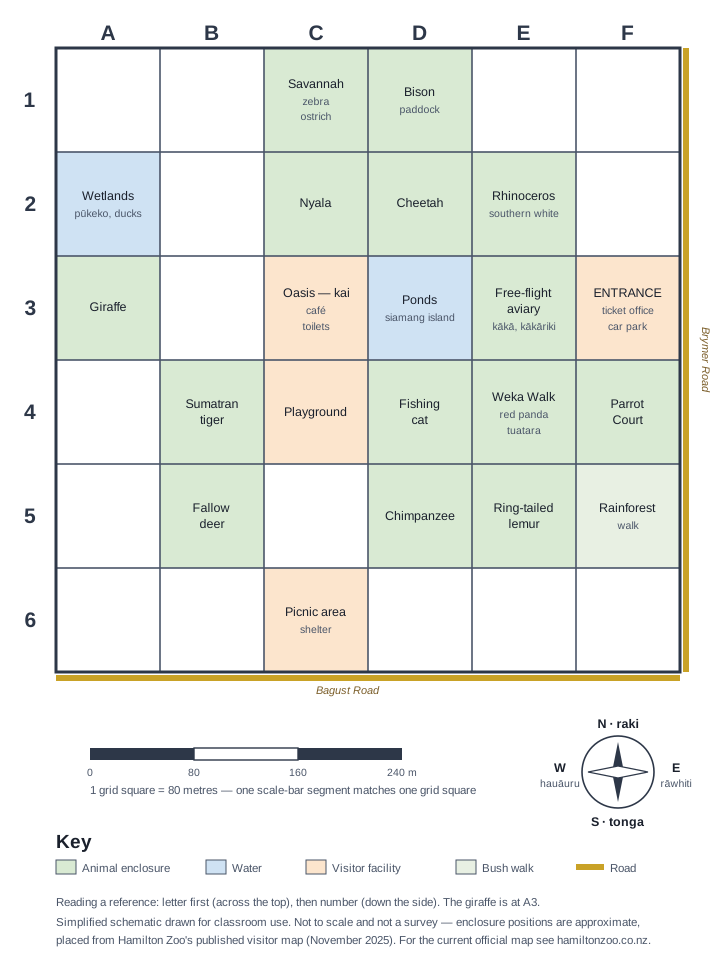
Activity 1: Find the Animals
Your first mission: Find where each animal lives!
Look at the map carefully. Each animal has its own special area.
Giraffes live at: Letter Number
Elephants live at: Letter Number
Tigers live at: Letter Number
Activity 2: Learning Directions
🧭 Direction Helper
From your START point, which direction do you need to go to reach:
The Giraffes:
The Elephants:
Activity 3: Measuring Distances
Let's count squares to see how far you need to walk!
Put your finger on the START point and count squares to each animal.
| Animal | Squares Right/Left | Squares Up/Down | Total Steps |
|---|---|---|---|
| Giraffes | |||
| Elephants | |||
| Tigers |
Activity 4: Plan Your Perfect Zoo Day
You want to visit all the animals, but in what order?
Look at your "Total Steps" from Activity 3. Which animal takes the fewest steps to reach?
My Zoo Visit Plan:
🥇 First, I'll visit: (because it's closest)
🥈 Second, I'll visit:
🥉 Third, I'll visit:
Activity 5: Emergency Helper!
Uh oh! Someone dropped their lunch near the elephants!
A zoo keeper needs your help to find it quickly.
You need to give the zoo keeper directions from the START point to the elephants.
📻 Radio Message to Zoo Keeper:
"From the car park, walk for squares, then walk for squares. You'll find the elephants at grid !"
Activity 6: Become a Zoo Guide!
Congratulations! You're now ready to help other families!
A family asks you: "We want to see giraffes, then get some food, then see elephants. Can you help us?"
🗺️ My Expert Guide Instructions:
1. Giraffes are at:
2. Food area is at:
3. Elephants are at:
My helpful tip:
🎉 Amazing Work! You're a Zoo Explorer! | He Mahi Miharo!
You've mastered all the Phase 2 map skills!
✅ What You Can Do Now:
- 📍 Find places using grid references
- 🧭 Use compass directions
- 📏 Count squares to measure distance
- 🗺️ Plan efficient routes
- 👥 Help others using maps
🌟 Ready for Next Level:
- 🎯 More complex coordinates
- 📐 Precise measurements
- 🔢 Scale calculations
- 🧮 Mathematical planning
- 🏗️ Design your own maps
🎯 Teacher Notes | Ngā Kōrero Kaiako
📚 NZ Curriculum Phase 2 Alignment:
📐 Geometry & Measurement:
- Use simple grids and directions to communicate position
- Give and follow directions for movement
- Describe position using everyday language and grid references
- Compare lengths and distances informally
🔢 Number & Algebra:
- Count collections and sequences
- Add and subtract numbers using various strategies
- Use number to solve everyday problems
- Communicate mathematical ideas clearly
🎓 Differentiation Strategies:
🟢 Support (Year 4):
- Work with buddy/adult
- Use physical manipulatives
- Focus on Activities 1-3
- Simplified language
🟡 Core (Year 5):
- Complete all activities
- Explain reasoning
- Work independently
- Help support group
🔴 Extension (Year 6):
- Add diagonal movements
- Create own grid references
- Calculate actual distances
- Design new zoo sections
🌿 Cultural Integration:
- Te Reo Māori: Direction terms (raki=north, tonga=south, etc.)
- Wayfinding: Traditional Māori navigation methods
- Place-based: Connection to Hamilton/Kirikiriroa as place
- Conservation: Kaitiakitanga values in zoo context
🎬 Media Anchor (8 mins)
Media Anchor: Taking a 4-figure grid reference (Ordnance Survey, 1m52)
Real source: Ordnance Survey (UK), How to take a 4-figure grid reference with Steve Backshall. Runtime 1m52. Replaces a clip that was previously mislabelled here and had no grid-reference content.
- Steve Backshall reads the reference along the bottom first, then up the side. Say that rule aloud together before Activity 1 — it is the move ākonga most often get backwards.
- The clip uses a British Ordnance Survey map. Our zoo map uses letters and numbers instead of four digits. What stays the same about the method, and what changes?
Curriculum alignment
- Geometry — Knowledge: - An alphanumeric grid reference is a system that divides a map into labelled rows (letters) and columns (numbers), so that each square can be identified by combining a letter…
📋 Teacher Planning Snapshot
Ngā Whāinga Ako — Learning Intentions
Students will apply mathematical thinking to authentic contexts at Te Kāhui Kararehe o Kirikiriroa (Hamilton Zoo), developing tūhuratanga (statistical inquiry) skills through real data about animal populations, habitats, and conservation. This unit connects maths to kaitiakitanga — our responsibility to care for ngā manu me ngā kararehe of Aotearoa.
Ngā Paearu Angitū — Success Criteria
- ✅ I can collect, display, and interpret data about animals using appropriate graphs and statistics.
- ✅ I can apply measurement, geometry, or number skills to solve real problems in a zoo context.
- ✅ I can connect mathematical findings to conservation and kaitiakitanga for native species.
Differentiation & Inclusion
Scaffold support: Provide pre-drawn graph templates and data tables for entry-level access. Offer extension tasks requiring students to design their own statistical investigation using zoo population data and write a conservation recommendation backed by evidence.
ELL / ESOL: Pre-teach mathematics and conservation vocabulary. Use visual supports — diagrams, models, and real objects where possible. Allow students to explain their mathematical thinking verbally before writing.
Inclusion: Offer manipulatives and calculator access to support all learners. Neurodiverse learners benefit from structured inquiry frameworks, clear success criteria, and choice in how they present mathematical findings. The hands-on, real-world context of zoo mathematics motivates engagement across learning profiles.
Mātauranga Māori lens: Connect to traditional Māori knowledge of kararehe and manu — including the significance of native species like tuatara, kiwi, and kākāpō in tikanga Māori. Use maramataka (traditional Māori lunar calendar) as a context for data and pattern recognition. Frame conservation mathematics as a practical expression of kaitiakitanga.
Prior knowledge: Best used after foundational statistics and measurement skills. Connects well to science ecology units.