🗺️ Hamilton Zoo Grid Explorer 🦁 Kaitūhura Tarawhiti Kōpere Kirikiriroa
🎯 Mission Brief
You're about to become a zoo map expert! 🎉
Look for the red START HERE point on the map.
🧭 What You'll Learn:
- Grid References: Letters and numbers
- Directions: N, S, E, W
- Distance: Counting squares
- Map Skills: Reading symbols
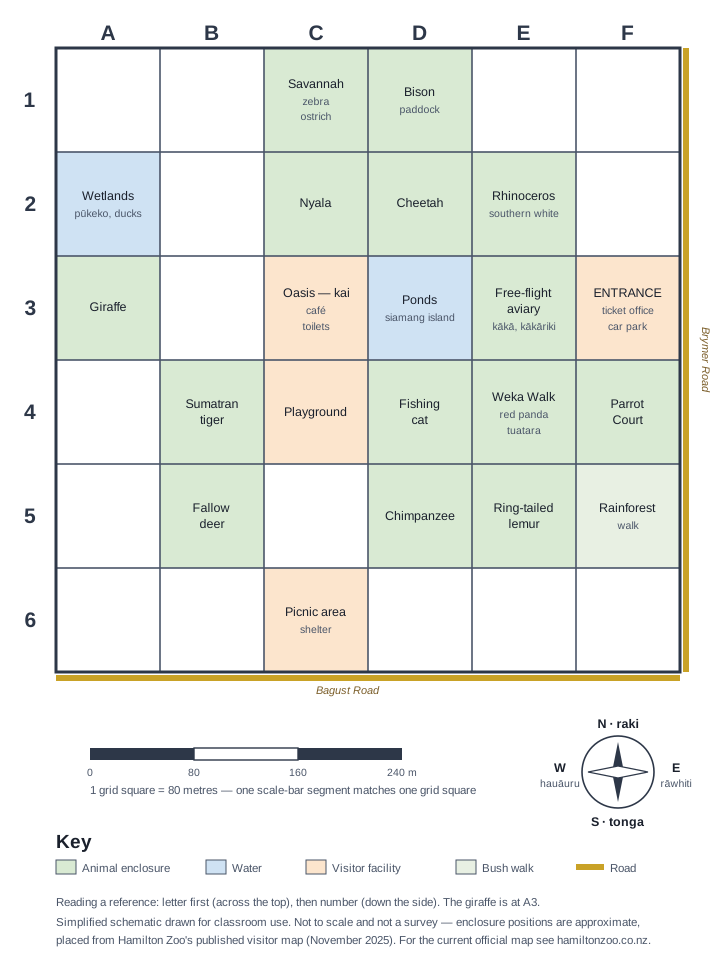
Activity 1: Find the Animals
Your first mission: Find where each animal lives!
Look at the map carefully. Each animal has its own special area.
Giraffes live at: Letter Number
Elephants live at: Letter Number
Tigers live at: Letter Number
Activity 2: Learning Directions
🧭 Direction Helper
From your START point, which direction do you need to go to reach:
The Giraffes:
The Elephants:
Activity 3: Measuring Distances
Let's count squares to see how far you need to walk!
Put your finger on the START point and count squares to each animal.
| Animal | Squares Right/Left | Squares Up/Down | Total Steps |
|---|---|---|---|
| Giraffes | |||
| Elephants | |||
| Tigers |
Activity 4: Plan Your Perfect Zoo Day
You want to visit all the animals, but in what order?
Look at your "Total Steps" from Activity 3. Which animal takes the fewest steps to reach?
My Zoo Visit Plan:
🥇 First, I'll visit: (because it's closest)
🥈 Second, I'll visit:
🥉 Third, I'll visit:
Activity 5: Emergency Helper!
Uh oh! Someone dropped their lunch near the elephants!
A zoo keeper needs your help to find it quickly.
You need to give the zoo keeper directions from the START point to the elephants.
📻 Radio Message to Zoo Keeper:
"From the car park, walk for squares, then walk for squares. You'll find the elephants at grid !"
Activity 6: Become a Zoo Guide!
Congratulations! You're now ready to help other families!
A family asks you: "We want to see giraffes, then get some food, then see elephants. Can you help us?"
🗺️ My Expert Guide Instructions:
1. Giraffes are at:
2. Food area is at:
3. Elephants are at:
My helpful tip:
🎉 Amazing Work! You're a Zoo Explorer! | He Mahi Miharo!
You've mastered all the Phase 2 map skills!
✅ What You Can Do Now:
- 📍 Find places using grid references
- 🧭 Use compass directions
- 📏 Count squares to measure distance
- 🗺️ Plan efficient routes
- 👥 Help others using maps
🌟 Ready for Next Level:
- 🎯 More complex coordinates
- 📐 Precise measurements
- 🔢 Scale calculations
- 🧮 Mathematical planning
- 🏗️ Design your own maps
🎯 Teacher Notes | Ngā Kōrero Kaiako
📚 NZ Curriculum Phase 2 Alignment:
📐 Geometry & Measurement:
- Use simple grids and directions to communicate position
- Give and follow directions for movement
- Describe position using everyday language and grid references
- Compare lengths and distances informally
🔢 Number & Algebra:
- Count collections and sequences
- Add and subtract numbers using various strategies
- Use number to solve everyday problems
- Communicate mathematical ideas clearly
🎓 Differentiation Strategies:
🟢 Support (Year 4):
- Work with buddy/adult
- Use physical manipulatives
- Focus on Activities 1-3
- Simplified language
🟡 Core (Year 5):
- Complete all activities
- Explain reasoning
- Work independently
- Help support group
🔴 Extension (Year 6):
- Add diagonal movements
- Create own grid references
- Calculate actual distances
- Design new zoo sections
🌿 Cultural Integration:
- Te Reo Māori: Direction terms (raki=north, tonga=south, etc.)
- Wayfinding: Traditional Māori navigation methods
- Place-based: Connection to Hamilton/Kirikiriroa as place
- Conservation: Kaitiakitanga values in zoo context
Kaiako Planning Snapshot
Ngā Whāinga Akoranga — Learning Intentions
- Use alphanumeric grid references to locate animals and features on the Hamilton Zoo map.
- Apply compass directions to describe and plan routes between zoo enclosures.
- Count grid squares to compare distances and optimise a zoo visit route.
Paearu Angitu — Success Criteria
- I can give the correct grid reference for each animal's location.
- I can describe a route between two animals using compass directions.
- I can calculate which animal is closest (fewest grid squares) and use that to plan my visit order.
Teacher Planning Snapshot
- Year level: Years 4–6 (Phase 2) | NZC Level 2–3 Mathematics and Statistics — Geometry
- Mātauranga Māori: Kaitiakitanga is embedded in the zoo context — students encounter animals as beings in our collective care, not just data points on a grid. Hamilton/Kirikiriroa as a named place connects spatial learning to tūrangawaewae. Students can explore te reo Māori compass terms (rāwhiti, hauāuru, raro/tonga, runga/raro) and connect route-planning to traditional Māori wayfinding using stars, landscape, and tides.
- Entry support: Provide a colour-coded map with animal icons. Pre-teach grid reference convention ("across first, then up") with a simple 3×3 practice grid before the full zoo map.
- On-level: Follow the 5-activity sequence. Use discussion prompts: "How do you know?" and "Can you find a shorter route?" to extend mathematical talk.
- Extension: Introduce simple scale (1 square = 50 m) and calculate real distances. Design a new zoo section and write grid-reference clues for a partner.
Inclusion and Accessibility
- ESOL / ELL: Compass direction vocabulary card with visual arrows. Te reo Māori animal names encouraged. Partner map-reading tasks reduce individual language demand.
- Accessibility: Large-format printable map available. All activities support verbal response. Digital version supports zoom and text-to-speech.
- Neurodiverse learners: Step-by-step activity cards with one task per card. Physical grid walk before abstract map tasks. Consistent spatial orientation throughout reduces working memory load.
Curriculum alignment
- Geometry — Knowledge: - An alphanumeric grid reference is a system that divides a map into labelled rows (letters) and columns (numbers), so that each square can be identified by combining a letter…
- Text Studies — Knowledge: Communication for Learning — Knowledge (Phase 1): - Words can be used to ask for help, share needs, and express preferences (e.g., 'can you help me please?', 'I like this …').…
- Language Studies — Knowledge: Communication for Learning — Knowledge (Phase 1): - Words can be used to ask for help, share needs, and express preferences (e.g., 'can you help me please?', 'I like this …').…
- Text Studies — Practices: Goal-setting language (e.g. ‘My goal is to …’, ‘I’ll try to …’) can be used to express intentions and plan learning. Emotion words (e.g. ‘frustrated’, ‘proud’, ‘confused’) and…
- Language Studies — Practices: Goal-setting language (e.g. ‘My goal is to …’, ‘I’ll try to …’) can be used to express intentions and plan learning. Emotion words (e.g. ‘frustrated’, ‘proud’, ‘confused’) and…